How To Catch Big Bass With A Freshwater Fishing Pursuit For Lunker Largemouths
Do you want to know how to catch big bass!?...
Or are you satisfied with landing one small fish after another?
What are some of the best freshwater fishing tactics for locating those huge monster trophy bucketmouths?
What's the "secret" to catching those giant largemouth bass?
All these questions and more will be discussed below to help you figure out how to get after those giant bass.
How big are the bass you're catching?
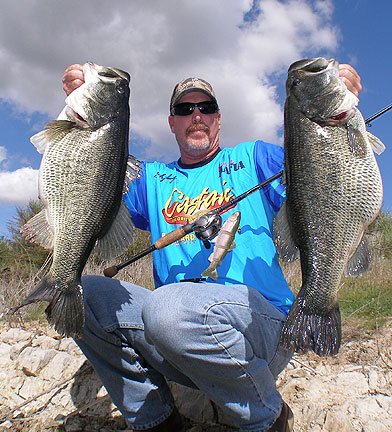 Mike Long with Two Monster Bass Using a Castaic Swimbait.
Your Mission: How To Catch Big Bass
It's always exciting to get into a school of largemouth bass and reel in one after another. Or, just to catch a bunch of fish throughout the day. However, the ultimate goal is to catch big trophy sized bass. After all, that is one of the reasons that makes this sport as fun as it is and keeps us going back out on the water.
If you ever been in any bass tournaments, or watched the professional tournaments on television, what do you think is their approach? After they have located spots that are holding fish, their primary goal is to limit out first. Then they go on a hawg hunt, and most seem to just know how to catch big bass every time.
Of course there is a little bit of luck involved, however, it
takes a whole lot of knowledge, skill and patience in understanding
how to catch big bass. If you already have the understanding of
catching bass, then there are only a couple more things that you need
to consider doing to help you catch and land the
big ones.
Dedicated To Catching Big Bass
It helps considerably to have the dedication and patience to seek out
bigger bass. Don't plan on catching many fish at all, except for the
ball busting bucketmouths. There are exceptions to that, though.
Suppose you are at a spot that you know holds big fish but, only small
ones are hitting your lures. You have to weed through those smaller
ones to get to the bigger ones. And sometimes, leave that spot to allow
it to settle, and then go back to it again in a couple of hours.
Big Bass Weapons Of Bass Destruction
Make sure that you are using the proper tackle. I would recommend a 7 to 7½ foot rod with medium/heavy to heavy action.
The fishing line you use will depend upon what lures and style
you will use. Braided lines and fluorocarbon lines that refract light
will be best. 65 lb. test for braid ought to do the trick for heavy
cover. And 20 pound fluorocarbon should generally be a safe bet for big
wake bait lures.
Arsenal For Big Fat Bass
The bigger your lure, the better. Big bass feed on big bait. Match the hatch. Figure out what they are feeding on in the particular water that you will be fishing... trout, bluegill, shad, minnows, perch, crayfish, etc.
Swimbaits and wake baits are always a nice choice on how to catch big bass. The hollow bodied swimbaits are pretty awesome. They are realistic looking and can get right down deep into the strike zone to entice more strikes that otherwise would not have.
Bigger bass don't like to exert a whole lot of energy to feed. So they wont go after a bunch of small bait fish. They prefer to pick on big prey with some size.
Trout colored wake baits are popular among bass anglers, and big largemouth bass love them too. Many are fished on top of the waters surface, while others are sub surface. Most are jointed to give a more realistic presentation. Some of them, when fished properly, will act so life like that they can be manipulated to turn around as if they are looking back at its predator.
Other popular lures known to attract large bass are the jig 'n
pig, brush hogs, snake lures, and 10 inch power worms. The power worms
are one of my favorites to use. Although I get quite a few smaller fish
hitting those which is always fun, the big ones just crush it. They go
for the head like they are trying to kill it. Awesome stuff! The colors
I usually prefer to use are the junebug or the black with blue tail.
But, it really depends on the water clarity and weather conditions.
Hooks and Weights For Catching Big Bass
The treble hooks that come with wake baits shall do fine. You may
change them out if you desire to. Swimbaits sometimes come with both
treble and single hooks, and some allow you to rig them how you wish.
For soft plastics, I recommend 4/0 to 5/0 extra wide gap barbed hooks.
1½ ounce to 1¾ ounce tungsten weights shall be efficient for punching
through the mats with soft plastics.
Know Where And How To Catch Big Bass
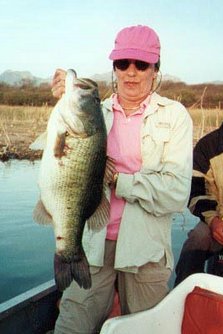
It would be an excellent resource to have a map of the area of water that you are going to fish. And even the use of high definition electronic imaging of a GPS tracker and depth finder so that you can decipher where the key spots are that are known to hold fish.
The areas to look for would include sudden and various changes in the contour along the bottom of the waters. Things like drop offs, extended points, and structure such as docks, laydowns, vegetation and rip rap. Especially look for anything different and out of the ordinary. All of these areas are known to hold bass.
You should be able to locate fish on your sonar. But the big girls like to hide, so be aware of that.
Make multiple casts until you have completely covered and exhausted an area that you feel should be holding fish. Sometimes it may take a few casts to aggravate the bass enough to trigger a strike.
Big bass don't get big by accident. They are generally very cautious and smart. Another scientific fact is that the less fish in a particular body of water, the bigger they can get, and the greater the number of bigger fish there will be. This is because they are not having to compete as much in the food supply.
Some waters are widely known to hold big largemouth bass. One
particular place that come to mind is Lake El Salto in Mexico. That
lake is packed with a lot of big tackle bustin' bucketmouths. Consider
reserving a guide if you plan on making a trip there. A guide should be
able to show you how to catch big bass.
Stealthy Presentations Is Key When Fishing
Whatever kind of lure you choose, the key is to fish it with slow to medium retrieves. Like I mentioned above, bigger bass don't like to waste much energy on chasing down prey. Try to drop your bait in as quietly as possible so as not to spook the fish. You can cast your presentation out past the point of your intended target of where you expect the bass to be hiding. As you slowly make your retrieve, even pausing at times, the bass should come out of its ambush point to bust on your lure.
To figure out how to catch big bass then your approach must be
as quiet as possible as well. The fish can feel the vibrations of
footsteps walking the bank, trolling motors, noise inside a boat, and
so on.
Best Times To Fish For Lunker Largemouth Bass
It is a fact that the majority of the record bass that have been caught and documented have been caught in the spring.
The months of February through May is their pre-spawn stages. During these times, their hormones are kicking in, they become vulnerable and less cautious. They are moving up into shallow waters to bed and spawn, so you can do some sight fishing.
Early morning, late evenings, or even cloudy parts of the day should be susceptible for top water presentations, while mid day will be better suited for subsurface lures. Keep in mind that fish don't like to look up into the sun.
In a highly fished area of water, go bass fishing at night if possible. Most of the larger sized fish will start roaming around at night because they feel safer. However, figuring out how to catch big bass in the dark can be difficult. Take a buddy and a light.
Best of luck on the water! Be sure to let us know about your
trophy catch and if this helped you with how to catch big bass. Don't
get discouraged if you don't get them right away. Maybe next time. The
giants aren't easy to come by. The more time you spend on the water,
the better your odds are in hooking into your huge trophy largemouth
bass. Good luck freshwater fishing!
Show Off Your Largemouth Bass
Cast us a line and tell us about your largemouth bass fishing.
As a matter of fact, you can share
your largemouth bass fishing pictures here.

NEW Merch Available Now!

Recent Articles


-
Monster Trinity River Alligator Gar
Sep 21, 23 11:30 AM
 Great Father and son day on the Trinity River in Palestine, Texas July 16, 2023. My son, Air Force Lieutenant Andrew Jordan Grove landed this 218lb, 7
 -
Spinner Bait Fishing For Pike And Caught This Lunker
Jul 22, 23 05:10 PM
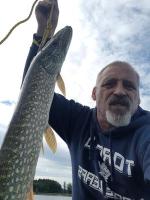 Spinner bait fishing for pike and caught this lunker at Valens Lake in Ontario, Canada.
 -
Sacramento Delta “Top Water Action”
Jul 22, 23 04:45 PM
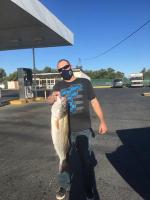 My name Is D.C. My backyard resides on the East Sacramento Delta. Anyhow, I was throwing a 9 inch Cotton Cordell Pencil Popper (red and white in color).
Facebook Comments
Leave a comment, question or tip in the box below.