Selecting The Right
Bluegill Fishing Tackle
Choosing the proper bluegill fishing tackle is essential if you expect to have the best results when freshwater fishing for these little giant heavy hitters.
These sunfish may seem simple enough for catching, but you can't just use any sort of all around equipment and believe that you can get a boat load of fish.
There's no doubt that you will need to go small when selecting bluegill fishing tackle. How small?
The following is a simple checklist to use as a basic guideline when selecting the proper tackle to fish for bluegill with a higher success rate for catching them.
Bluegill Fishing Tackle Checklist
Bluegill Fishing Rods
Your fishing rod should be of ultra-light to light action. Anything more than that will just be way too much power and action, which is unnecessary. A fiberglass fishing rod is great for mustering the hard nosed bluegills to the surface. Graphite, and composites of, can be just as efficient to get the job done in most cases.
The length doesn't have to be any longer than 6 feet. I personally will often use a 5' 6" rod for most instances when fishing for bluegill. Many anglers even prefer much smaller rods, especially ice fishermen, which are often around 2 to 3 feet in length.
Fishing Line For Bluegills
The fishing line only needs to be of the lightest pound test.
Either 2, 4 or 6 pound test at the most will be all that's necessary.
Monofilament, as opposed to braid or fluorocarbon, provides the best
results for fooling these feisty sunfish. The small diameter of a light
pound test mono line is much less visible to the fish, and the
stretchiness helps to allow the fish to take the bait long enough to
get a good hook set.
Hook Selections For Bluegill
There are a variety of hooks to choose from to take care of the business end. Basically, and to keep it simple, #6, #8 and #10 size hooks are the most effective. They come in a variety of styles as well. The thin wire hooks are better for holding smaller baits. And longer shank hooks make it easier to remove them from the bluegills small mouth.
Using Live Bait And Lures For Bluegill
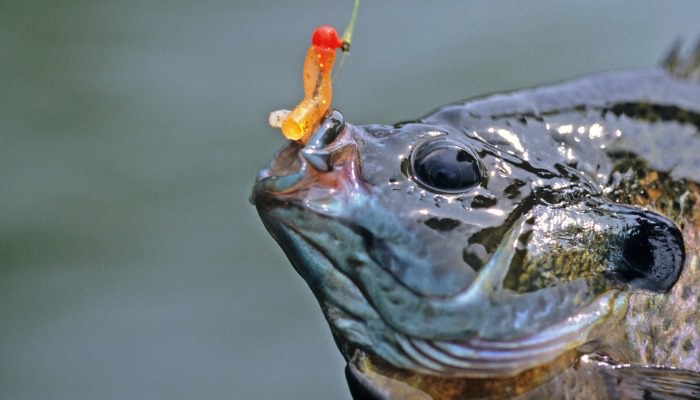
Jig heads tipped with live bait are productive. Or, instead of using bluegill bait, you may opt to fish with lures. Small scaled spinner baits, inline spinners, micro jigs, miniature soft plastics such as tubes, grubs and worms, and will occasionally hit small poppers and just about any kind of flies.
I like to use 1/64 ounce to 1/32 ounce leadheads tipped with 2 inch curly tail grubs. The key is to leave as much of the hook point exposed as possible. The reason is because bluegill don't exactly crush a bait the way a bass would, so this ensures you get a good hook set without pulling the lure from their mouth.
Using Floats For Bluegills
One of the most important, yet sometimes overlooked, pieces of equipment for your bluegill fishing tackle is a float. Some anglers don't believe in using a float, while others realize it's one of the best ways to keep your presentation right to the exact depth and location that the fish are holding at. A small bobber, or better yet, a slip float rigged with a threaded bobber stop will keep the float from moving up or down the line, thus preventing possible damage to your light monofilament line.

NEW Merch Available Now!

Recent Articles


-
Monster Trinity River Alligator Gar
Sep 21, 23 11:30 AM
 Great Father and son day on the Trinity River in Palestine, Texas July 16, 2023. My son, Air Force Lieutenant Andrew Jordan Grove landed this 218lb, 7
 -
Spinner Bait Fishing For Pike And Caught This Lunker
Jul 22, 23 05:10 PM
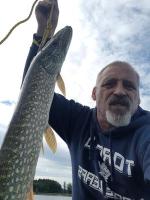 Spinner bait fishing for pike and caught this lunker at Valens Lake in Ontario, Canada.
 -
Sacramento Delta “Top Water Action”
Jul 22, 23 04:45 PM
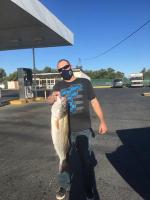 My name Is D.C. My backyard resides on the East Sacramento Delta. Anyhow, I was throwing a 9 inch Cotton Cordell Pencil Popper (red and white in color).
Facebook Comments
Leave a comment, question or tip in the box below.