Bass Fishing Techniques That Are Best For Catching Lunker Largemouth Bass
Here's some bomb bass fishing techniques to go bonkers for busting bass from your boat or on the banks.
With countless lures available for catching bass, each requires the proper methods to increase your odds of landing more bass.
There are many bass fishing techniques spread throughout this site, however, we have listed a few important basics here on this page to help you out on the water and catching those feisty bass in no time.
These strategies are sure to assist beginners, and should keep the more experienced angler refreshed and reminded of the proper methods for freshwater fishing for bass.
There are many techniques which can be applied to any given lure. Likewise, there are many things to consider with your approach, and much has to do with the conditions.
The subject of bass fishing techniques is so broad. It's ultimately up to the fisherman to decide which approach to utilize in regards to conditions of the region, weather, water, and their style.
Soft Plastics and Worm Fishing Techniques
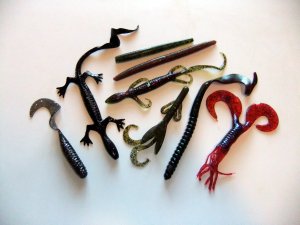 Soft Plastics:
Worms, Lizards, Grubs, Crawfish, Brush Hogs
Soft plastics and worms are very versatile and can be used in a variety of bass fishing techniques.
They can be rigged in a number of styles such as Texas, Carolina, Wacky, Weightless, Drop Shot, or Split Shot.
Whichever way that you rig them, cast out and fish them until you establish a pattern for how the fish want it.
Dead sticking is a good option in colder water, or even in muddy water. This technique is also effective when bass are extremely stubborn. You pretty much have to force feed them by putting an easy meal right in front of their face.
Cast out, let the worm sink to the bottom, then allow it to sit there for about 8 seconds. Then give it a little twitch or a crank of the handle and let it sit again for a few seconds. Continue to repeat the process until you get a strike.
The warmer the water temperature is then the more you can get away with moving it. You can do a lot of things with a plastic worm. You can twitch it, pop it, drag it, let it float or drift weightless, or even swim it. I have used all of these bass fishing techniques for plastic worms with excellent results.
Often times, beginners are too quick with pulling it through
structure in fear of becoming hung up. Structure is where the bait is
going to excel. The plastic worm is generally a snag proof lure. Get it
in there and let it work for you.
Crankbait Fishing Techniques For Bass
 Shallow and Deep Diving Lipless Crankbaits
Bass fishing techniques using crankbaits are pretty simple and easy to master. The nice thing about crankbaits is that they cover a lot of water fairly quickly.
Crankbaits are sold in many colors, shapes and sizes. Some of the other options include shallow to deep running, lipless to extra wide bills, a lot of wiggle action, very tight action, or beads for clacking and rattle noise. Newer versions are incorporating scent inserts, red LED lights, and extra weight chambers.
The technique known for these is chuckin' and windin'. Cast out your plug and reel it in. You can flip them into pockets or pitch them out deep. Rip it through structure. Bouncing it off rocks or tearing it through vegetation will often trigger strikes. Change up your cadence until you figure out how they want it. A stop and go retrieve will often entice them to bang it on the pause.
Spinnerbait Techniques For Bass
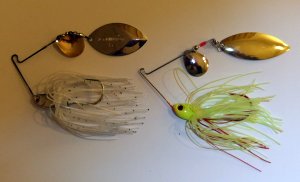 Strike King Spinner Baits:
 Pearl White & Chartreuse with Blood Red Hook
Legendary professional bass anglers like Jimmy Houston, Bill Dance and Hank Parker are very well versed with spinnerbaits. They are among the best in the business with spinnerbait bass fishing techniques. From the common overhand cast, the sidearm, to Hank's classic roll cast.
Don't limit your chances of enticing bass to attack by staying one dimensional with a spinnerbait. By that I mean, don't just cast and retrieve. Vary your retrieves from fast to slow, and pausing at times. Allow the blades to work for you. The blades will flutter when you let the lure fall. It's not too often that these get hung up so fish it in heavy structure. If the bass are just nipping at the back end of it, then add a trailer hook to it.
Top Water Tactics and Techniques
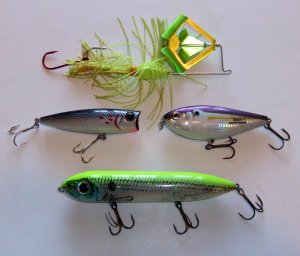 Top Water Bass Fishing Lures:
Buzz Baits, Pencil Poppers, Stick Baits
Top water lures can range from poppers, stick baits, plastic frogs, prop baits, and buzz baits just to name a few. Using these baits will tend to produce large sized bass.
The best times to fish them is early morning or late evening. I've caught bass with these all through out the day as the conditions where right, with a slight overcast in the sky. The water should be calm or at least not choppy.
Once you cast and the lure hits the water, patiently wait to allow the water and ripples to calm around it. Then give it a jerk or two and let it sit again. Vary your cadences. Twitch it or rip it through the water. A lot of times the bass will bust on it when it has stopped, or will chase it down if it feels like it is trying to get away.
Make sure that you feel the pressure from the bass on your line before you set the hook. I've seen many times where the bass attacks the lure and misses it. Sometimes they'll swirl around it or knock it into the air before they get it in their mouth.
Jig Fishing Techniques For Bass
 Jigs are great crawfish replicas.
Jigs are another versatile lure for catching some nice sized bass. There is a big selection of jigs and a large amount of interchangeable accessories to customize them.
The more time you spend fishing these, the more you will learn about the multitude of bass fishing techniques that you can incorporate into your game.
You can flip and pitch them into pockets or heavy cover. Drag or bounce them off the bottom or rocks. Or simply stop and go to allow them to swim or flutter with the fall of the pause.
With time and experience, you should develop a good feel for it. The idea is to maintain control of the lure and the line. The line shouldn't be so tight that the bass could feel the pressure as it tries to suck it up. And too much slack in the line wont allow you to feel much of the structure the jig is passing through.
Spoonin' Techniques For Bass Fishing
Spoon jigs look and seem easy enough for anybody master. However, the bass fishing technique of vertical jiggin' spoons can present problems of line tangles and hang ups. You can change out the split rings and replace them with a snap swivel, switching it with the hook end. This shall decrease the amount of possible tangles while jiggin'.
Jiggin' spoons are best during the cold seasons of fall and winter. Locate schools of baitfish and bass with your sonar electronics and get right on top of them. Drop your spoon in right down on top of the school while maintaining control of your line. The spoon will flutter down with subtle to erratic actions. A lot of times the bass will hit it hard on the fall.
To jig it, simply lift your rod tip just a few inches and lower it back down. The few inches will cause the spoon to shoot up a couple or so feet in the water before fluttering back down. You can vary your lifts from slow to thrusting fast. A spoon can also be cast out and reeled back in if you want to swim it. Go get jiggy with it!
Subtle Baits For Bass
Many
of the subtle smaller baits such as p-heads, darters and grubs can
be fished about the same way as jigs and plastic worms. Since they are
smaller and weigh less, lighter tackle should be used. Extra light to
light spinning tackle should fair just fine.
Flippin' and Pitchin' Techniques For Bass

Flippin' and pitchin' is a bass fishing technique used exclusively by many bass anglers all throughout the world.
There are many different lures that can be used such as the jig 'n pig, crankbaits, tubes or plastic worms, just to name a few.
You can flip into pockets, along weed lines, or into deep or heavy cover.
1. To start, hold your flippin' rod out and let out enough line as far as possible without the lure getting in the way or distracting a free motion.
2. Pinch the line from the bottom section of the rod and pull as much of it away in a comfortable arms reach.
3. Using the motion of the rod, swing the lure and release the pinched line to send the lure forward and towards your intended target.
4. Let it sit for a moment, twitch it once or twice, then
crank it back in.
Live Bait Fishing Techniques
Nightcrawlers, crawdads, shad, minnows, mudsuckers and crickets are some of the favorite foods for a delightful bass meal.
Do you really need to know the bass fishing techniques for live bait? Okay, fine...
All you need is a hook, line and sinker. Bait the hook, throw
it out
there, pop open a cold one, kick back, relax and wait. When your pole
doubles over and your line starts screaming, bring her in!
Show Off Your Largemouth Bass
Cast us a line and tell us about your largemouth bass fishing.
As a matter of fact, you can share
your largemouth bass fishing pictures here.

NEW Merch Available Now!


Recent Articles


-
Monster Trinity River Alligator Gar
Sep 21, 23 11:30 AM
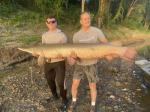 Great Father and son day on the Trinity River in Palestine, Texas July 16, 2023. My son, Air Force Lieutenant Andrew Jordan Grove landed this 218lb, 7
 -
Spinner Bait Fishing For Pike And Caught This Lunker
Jul 22, 23 05:10 PM
 Spinner bait fishing for pike and caught this lunker at Valens Lake in Ontario, Canada.
 -
Sacramento Delta “Top Water Action”
Jul 22, 23 04:45 PM
 My name Is D.C. My backyard resides on the East Sacramento Delta. Anyhow, I was throwing a 9 inch Cotton Cordell Pencil Popper (red and white in color).
Facebook Comments
Leave a comment, question or tip in the box below.